Showing posts with label uni. Show all posts

Marketing & Consumerism : Intro


"Although the scope of marketing is to understand and fulfil consumer’s needs and wants, the influence exercised by various marketing activities is such that may create needs. This distortion may generate economic imbalances, but in particular, it raises important ethical questions. This literature review undertakes a journey in the world of the marketing practice to understand how and why marketing can lead to over-consumption. 

Foreword
In 1979, on the eve of the American presidential election, Jimmy Carter, in his infamous “Crisis of Confidence” speech, warned that “too many of us worship self-indulgence and consumption”.
However, what followed this discourse was the victory of his opponent Ronald Reagan, the rise of Wall Street and ten years later the collapse of the Berlin Wall. 
Today, in 2009, after having experienced the demise of the Communism ideology and enjoying thirty years of incredible global economic growth, the world is urging for all the possible measures to fix a system (the Capitalism) on the brink of collapse has never been seen since the 1929 Depression.
Hence, on the streets, in the media and in the parliaments, the warning words of Jimmy Carter are echoing again. 
The present economic downturn has certainly questioned the validity of a model that despite guaranteeing the perfect functioning of a democratic society; today is blamed for having contributed to the rise of materialistic values and in particular to have cultivated a consumerist society.
Consumerism, as defined in the Oxford English Dictionary (1989), is “the doctrine advocating a continual increase in the consumption of goods as a basis for a sound economy”; though nowadays consumerism is perceived as a culture or a social order characterised by disproportionate consumption and excessive attachment to material possessions (Abela, 2006).

Although, anti-consumerism has always been present in society, the most puzzling aspect of this criticism is that much of condemnation often takes aim at the most successful and lauded companies; Nike, McDonald’s, Microsoft and Starbucks, to cite some, are relentlessly singled out as the cause of the consumerist degeneration of  society.
Indeed, the common denominator amid those big multinationals is that they are the same brands that today dictate trends, command a semi-religious following and interpret the needs of the population more than any politician or religion; but , most of all, they are the same brands that have taken the marketing concept to heart and industriously applied it (Holt, 2002).

Marketing is the management process responsible for identifying, anticipating and satisfying customers’ requirements profitably” (C.I.M cited in Adcock, Halborg and Ross, 2001 p.3).

It includes access to voluntary exchange processes, (the process of exchange in society is marketing; Kotler cited in Quelch and Jocz, 2008) and it facilitates this process with information and a distribution (of the product/service) that aims to reach as many consumers as possible (inclusion).
Still, despite these remarkable benefits, marketing does not do a good job in marketing itself (Quelch, 2009); in reality, the practice has always been at the centre of a criticism that has put in agreement religious, politicians, anti-global movement and academics as well.
Indeed, the critics argue that firms, through marketing, pursue only a single objective: to encourage consumption, thus generating over-consumption, waste and social disequilibrium.
Therefore, this accusation presumes the ability of marketing to influence consumers’ behaviour to an extent that it convinces consumers that Wiis and iPhones are necessary (Barber B. cited in The New York Times, 2007), thus creating needs.

The recent sophistication of marketing activities has certainly helped the practice to well understand and anticipate consumer requirements. Indeed, the commercial study of consumer behaviour and the web, presents nowadays the possibility to reach infinite consumers and the likelihood of getting to know a great deal about them.
Moreover, the persistent tentative of marketers to build a closer relationship with their customer has somehow raised the brand status (in the eyes of the latter) to a level where they can influence behaviour; definitely, a huge leap forward for marketing activity, though also an interesting ethical issue.
In fact, there is no doubt that nowadays brands command huge following; they have a great influence on the consumer’s preferences, attitudes, and purchasing decisions; the consumer buys not only into the product but also into the proposed lifestyle. A lifestyle that very often values wealth, success and power.
However, it is ‘In Brands We Trust’ and it is consumption, which defines meaning (Smith, 2007). Indeed, numerous are the examples of marketing activities that, making extensive use of the technique of persuasion to influence the consumer’s purchasing behaviour, imply that the consumption of particular goods can earn the acquisition of the social status represented.

Therefore assuming that marketing influences behaviour and that this influence promotes materialistic values, does the marketing practice promote consumerism?
Considering the various perspectives involved, the topic is very controversial; in reality, the search of an absolute truth that is a correlation between marketing and consumerism, so far has not produced relevant results.
Therefore,  before attempting any answer to the question, it is particularly important to test the hypothesis made above, hence a Positivist philosophy.
Thus, the deductive approach to the vast narrative available allows the drawing of a conceptual framework, or rather of a theory that would imply the responsibilities of marketing in the rise of consumerism. 
The structure of the literature review initially aims to analyse the marketing concepts and consumerism in the light of its socio-economic structure and consequently to focus on the perspectives regarding consumerist behaviour and ethics.   
However, in order to avoid generalising this complex topic that regards people and behaviour, an Interpretivism approach is utilised to draw the conclusions. 
Indeed, the research methodology follows an explorative and descriptive approach in order to test the hypothesis; in particular three areas are individuates as key to understand the causes for the inference (marketing and consumerism) to subsist.
Hence, the objectives of this study are:
  1. To explore the extent of the influence of marketing practices on consumer behaviour;
  2. To discuss the status of ethical standards in marketing; 
  3. To investigate the validity of the marketing concept in the current economic environment.

Vietnam


Introduction 

Vietnam’s development is without doubt one of the most successful stories of the last decade. The populous south-eastern country (85 million people; World Bank database, 2010), from being an impoverished and  isolated nation with a long history of wars and divisions has become, in the world of Ajay Chhibber (cited in The Economist, 2008) the “poster child” for economic development. Today, in 2010, Vietnam is on the verge of joining the middle-income countries’ group (World Bank, 2008), setting itself the ambitious target to become a rich, high-tech country by 2020 (The Economist, 2008).
Vietnam’s rise from poverty has started from a very low base; in 1989 its GNI per capita, PPP in dollars was just 610$, three and an half times less than an average middle income country and nearly thirty times lower than the GNI PPP $ of an high income country. Yet, Vietnam’s GNI PPP $ over nearly twenty years has increased more than threefold,  averaging an annual rate of growth of 8% , twice faster than an average high income country and a typical low income country. However, despite its notable progress, Vietnam is still a poor country compared to other Asian economies; though, Vietnam’s income level (GNI PPP $) has doubled in the period 2001-2008 while other ASEAN countries such as Philippines, Thailand, Indonesia have only registered an average annual increase of their income level in the range of 3-6%  

The striking characteristic of Vietnam’s growth is the progress made in the eradication of poverty and in other development indicators. Vietnam ranks at the 116th place in the latest Human Development report (2009), a position thirteen places higher than the equivalent GDP per capita table; a result that highlights the social and equitable focus of the Vietnamese development (Vietnam’s Gini coefficient is 0.37). In fact, Vietnam scores relatively well compared to other LDC countries in all the indicators that form the HDI index. It has met or it is likely to achieve six of the ten Millennium Development goals outlined by the United Nations Development Program (World Bank, 2008) and poverty has been reduced by two/thirds between 1993 and 2006; well beyond the target set by UNDP to halve the proportion of people living in poverty by 2015.

Vietnam has escaped deep poverty by embracing free trade;  as a result, Vietnam’s economy is today one of the world's most open with merchandise trade (exports plus imports) equal to 160% of GDP (World Bank, 2010).  The rapid integration of the Vietnamese economy explains 20% of the outstanding 7% average annual rate of GDP growth of the past twenty years.
If the size of the government is often determined by the degree of market failure in society, in a country such as Vietnam, in which private initiative was practically outlawed, it’s not surprising that the State has a major role in Vietnam’s economy. SOEs (State Owned Enterprises) still retain a major control over more “strategic” activities; in fact, the strongly nationally-owned character of Vietnam’s development strategy allows the government to have through the SOEs direct control over employment and FDI and thus fulfil its vision of an equitable development. However, despite the suspicion that often attracts the State’s involvement in the economy, SOEs have been maintaining a greater productivity compared to the private sector (Thoburn, 2004) resulting from years of experience of the Communist management’s elite in the field.   Nevertheless, its monopoly in the manufacturing sector has been partially declining (from 52% in 1995 to under 35% in 2006; World Bank, 2008) and a dynamic private sector is slowly emerging, sparking hopes that the country's latent entrepreneurialism has finally burst back into life (The Economist, 2008), although the generated share of output (22.7%) is still little more than an half of the share of foreign-invested enterprise (Thoburn, 2009). 

Commodity trade and Trade policy
The outstanding growth achieved by the south-eastern country certainly vindicates the many neo-liberals who advocates “trade as the main engine of economic development” (Todaro, 2009); indeed, Vietnam’s move to a market economy, its gradual integration into world trade and the swift openness to foreign investment have certainly helped sustaining a economic growth that has seen its total output tripling in 2008 to 90.7 US$ billions from 31.17 US$ billions in 2000 (World Bank Database, 2010).
The move towards a more open economy was the core of the trade strategy actuated with the doi moi reform programme in 1986. This approach, in line with the neo-classical theory, aimed at increasing the economic performance of Vietnam by integrating its economy in the global exchange of goods that is International trade. In fact, according to classical theory (Todaro, 2009), with trade a developing country can access goods that otherwise would be unable (or be too expensive) to produce in exchange for products in which it has a comparative advantage. Through this mechanism, based on the classical belief that trade allows a better allocation of resources (labour, land, capital), the country would focus on developing sectors of the economy where it is more efficient (in absolute or compared to its trading partners), hence where the margin of gains are greater. Indeed, the comparative advantage would be acquired by specialising in goods that have a relatively lower cost of production as explained by David Ricardo in his theory of comparative advantage (Todaro, 2009) or by maximising the use of factors which are abundant such as labour, as demonstrated by the Heckscher-Ohlin theory (Todaro, 2009). Though, the gains from trade arise because a bigger market allows economies of a large scale and so greater profits, because exposure to the world allows the access to foreign technology and finally because by opening the domestic market to foreign importers, internal competition is increased thus lowering the prices. (The Economist, 1998).
The increased integration of the economy also implies a notable change from its past. In fact prior to the “doi moi” reform plan, Vietnam was a rather isolated country; its isolationist approach, based on the concept of “developing from within” initially theorised by the Argentinean economist Raul Prebisch (cited in Cypher and Dietz, 2009), persistently pursued strict industrial policies of import substitution (ISI) aimed at manufacturing simple and non-durable goods that were being imported, while developing trade- links only with the former Soviet Union and other communist countries (Thoburn, 2009). Nevertheless, similarly to the unsuccessful attempts of other developing countries that engaged in inward-looking policies (Todaro, 2009), Vietnam also failed to sustain this strategy; indeed in 1986, Vietnam’s economy was surviving solely on aid flowing from the Soviet Union that shortly thereafter collapsed, inflation was over 700%, exports were only half the value of imports and there were severe shortages of food and consumer goods (Thoburn, 2009) that induced many desperate Vietnamese to flee the country (“boat people”, The Economist, 2008).  
However, although the evidence shows that the openness of its market to foreign goods has had a very positive effect on its rate of growth, Vietnam did not rapidly move towards a market-based system of foreign trade. In fact, Vietnam’s trade strategy, as in other Asian countries previously, was mainly centred on the development of an export-led industrialisation (ELI). Similar to ISI but outward looking; during this process the dismantling of imports restrictions such as tariffs and quotas happen quite gradually in order to protect the infant export industry from foreign competition while a programme of light industrialisation creates the basis for the creation of a competitive advantage in labour-intensive manufactures. Indeed, Vietnam’s effective rate of protection has been constantly high and it has only decreased recently as a result of joining the WTO in 2007
.
On the other hand, as noted in Cypher et al (2009) “an industrial revolution without an agricultural transformation would be a partial success”. Indeed, the de-collectivisation of the land (one of the biggest privatisations yet seen; The Economist, 2008) and the gradual alignment of farm prices toward market prices provided the basis for the spectacular development of the agricultural sector.   Vietnam from being a net importer of rice in the 1980 has moved to become the world second exporter (after Taiwan), resolving also the problem of food security, considering that at least 70% of population is a consumer of rice. Moreover, its produce is highly diversified; it ranges from coffee to nuts and from peppers to rubber (Thoburn, 2009). 

The Vietnamese process of modernisation of the rural area also went hand in hand with a gradual urban development. As often the success of structural changes of this sort are measured by the falling share of agriculture in the country's gross domestic product, Vietnam’s achievement is highlighted by the decline of its share of agriculture as percentage of GDP to a 20% in 2007 from the 46% of 1988, an average annual decline rate of 2.1% offset by a faster growth of the secondary and tertiary sector during the same period.

However, Vietnam’s strategic approach to export promotion was not limited only to the export of primary products but it was mainly intended for more productive and growth-inducing product lines. In fact, Vietnam has successfully been able to add manufactured goods to the existing export structure of the primary products (Fig. 6).  In 2007, the light industrial and handicraft goods represent the 45% of the export volume (in mill.USD; Fig.7). In fact, Vietnam’s diversification of its main manufacturing exports from garments and textiles into footwear reflects the country’s comparative advantage of a low-cost but high-quality labour force (World Bank, 2008) but also an effective strategy of limitation of export earning instability, a problem common to other Asian economies.

The positive characteristic of Vietnam’s development has been the successful although not complete transition to a more open economy. In fact, as protective tariffs were progressively reduced, the country has effectively managed to overcome common transactional inefficiencies that arise when moving from a highly protected economy to a more integrated one. In particular in three key areas, Vietnam created the conditions for a sustainable development; those are the economic climate, human capital and foreign investments.     
Economic stabilization and the early “doi moi” reforms were closely linked. In 1988 a severely restrictive monetary policy was introduced to reduce the very high inflation. In fact, years of isolation and imports restrictions had artificially overvalued the Vietnamese “dong”. Hence, as part of the export –promoting strategy, the government devalued the currency in order to raise the local prices that firms receive for goods that can be exported.  This policy certainly renders the exports much cheaper to foreign importers, though more significantly accounts for a “veiled” subsidisation of the exports. 
Moreover, Vietnam’s record of investment in human capital
, both in education and in health provision generated “receptivity to technical change” (Van Arkadie cited in Thoburn, 2009). But more importantly, Vietnam’s entry into the world markets has been much helped by foreign firms, following a foreign investment law passed in 1988 (Thoburn, 2009) that de-facto liberalised foreign direct investments (FDI).
Indeed, this combination of stable environment, low production costs and specialised human capital has helped Vietnam to become the darling of foreign investors and multinationals (The Economist, 2008). In 2006 Vietnam’s inward foreign direct investment flows were accounting for 12.5 per cent of its gross fixed capital formation, compared to 8 per cent in China (UNCTAD, cited in Thoburn, 2004). Global buyers have also had an important part in directing FDI to Vietnam; the favourable investment environment has attracted many manufacturing companies to outsource their production in the south-eastern country. Indeed for buyers that seek for a useful “insurance” against relying too heavily in China (a “China plus one” strategy), Vietnam is often chosen as “the plus one” (The Economist, 2008)    
Finally, in line with many development economists that argue that developing countries should orientate their trade toward their regional neighbours (Todaro, 2009) Vietnam joined the ASEAN (Association of Southeast Asian Nations) in 1995. The ASEAN bloc is formed by ten members
 of whom Vietnam is one of the poorest (only Cambodia, Laos and Myanmar have a lower GNI PPP per capita); this circumstance raises the possibility for the Vietnamese economy to gain from a closer integration with other rich members such as Singapore and large markets such as Indonesia which has a population of more than 200 millions.


In fact, integration provides the members countries the opportunity for a greater utilisation of their industries and to take advantage of economies of scale made possible by the expanded market (Todaro, 2009). Indeed, in 2008, more than 20% of the total of Vietnam’s imports and exports were part of an intra-ASEAN trade (table 4). But more importantly, the Asian region is Vietnam’s main source of imports while the United States, after having imposed an embargo on Vietnam’s goods that lasted until 1993, today they are the main destination of Vietnam’ exports (19% of total exports)

Conclusions 
Vietnam’s successful story cannot be told as a triumph of the market fundamentalists and neither as the umpteenth Asian miracle or a light version of China; instead, the specificity of Vietnam’s development may lie in its ability to incorporate the best aspects of successful development models into something uniquely suited to it.
Although Vietnam’s development is similar to other Asian countries such as Taiwan and South Korea, the economic reform programme initiated in 1986 certainly mirrors the same economic and social transformation undertaken by China in 1978. As its northern neighbour, Vietnam abandoned its effort to introduce real Communism, (evidenced in the collectivising land ownership and the repression of private initiative) to embrace Capitalism; it dumped strict autarkic policies and the disastrous economic central-planning system that isolated the country and brought Vietnam to the brink of a humanitarian catastrophe, to open its domestic market to foreign goods and investments. But, more importantly, as the People's Republic of China, Vietnam preserves an authoritarian government structure of a one-party state that still maintain a strong grip on political debate and the private enterprise initiative.
The Vietnamese government has had the merit of courageously abandoning the ideological doctrine for the good of its own people. As the developmental state assumed by Evans (cited in Cypher and Dietz, 2009), the Vietnamese apparatus has had the power, the purpose and the capacity of directing and mobilise its development vision. However, the development project undertaken by Vietnam has not been certainly characterised by a sudden “laissez faire” approach; instead of the invisible hand of the market, Vietnam’s development has been characterised by a very visible State. 
The main risk is that as the Communist ideology served as moral justification for the maintaining of the old status-quo, economic success may provide the pretext for the current regime to hang on to power. The role of the State has been certainly endogenous to the Vietnamese development; however this exploit has also been aided by external phenomena such as the increasing globalisation of the economies. Surely, the merit of the government has been to take full advantage of the global changes of the last twenty years, though many challenges lie ahead.
The latest financial crisis will definitely have the effect of re-balancing the world trade; this is likely to force Vietnam (as for other exporting countries) to stimulate the domestic demand to sustain its growth. However, Vietnam is still a very poor country, therefore, the extent of Vietnam’s reaction to external shocks will determine whether equality will be sustained or the problems facing the country will cause the government and other powerful interests to tighten their grip on the population and thus increasing discrimination. 
Because development must be conceived as a multidimensional process involving major changes in social structures, popular attitudes and national institutions (Todaro, 2009), if the Vietnamese government wants to continue to act as a developmental State it will have to certainly pave the way for the major freedom of its citizens and a declining authority of itself. It is often said that democracy is not a determinant in the development of a country and Vietnam may be the latest evidence, however it is worth remembering that that most of the world's richest countries by income per head are liberal democracies (The Economist, 2008); definitely another model to which Vietnam could aspire. 


Professional CV Review

My latest Curriculum reviewed by "The CV Centre" The UK's Leading CV Consultancy


Your CV avoids virtually all of the common mistakes most people make on their CVs and you are certainly to be congratulated for this! Definitely above average.

However, that is not to say that there is not definitely room for improvement! There are two particular areas we would like to go into some detail on:

Aesthetics
Whilst the presentation and layout of your CV is certainly good, rather than bad, it could undoubtedly benefit from some further work. Content is clearly very important - and we'll go into this in a little more detail below - but aesthetics are also critical in making the right impact on the reader. First impressions are absolutely vital. Besides eliminating any inconsistencies in formatting we work hard to carefully control the use of white space, presenting a client's information clearly and comprehensively - and with style - but within the limitations of the space available.

Content - Wording & Phraseology
Although it is beyond the scope of this review service to make specific and multiple recommendations in respect of wording and phraseology, ideally, all the wording needs to be looked at carefully by one of our consultants and selectively re-written by them according to their professional judgment. It is important to strike the right balance between too little and too much text, but it is of course extremely important to phrase your information in such a way as to sell yourself as effectively as possible. Your CV is your personal sales brochure and needs to be copywritten accordingly. This is something which can only really be done by an experienced professional. Our team of consultants has a broad range of previous experience within recruitment, personnel and HR, which enables them to produce CVs of the highest possible standards.

Rational Expectation model


Until the advent of the rational expectations (RE) hypothesis, initially put forward by J. Muth and later propagated by Robert Lucas and Thomas Sargent, the AE hypothesis was quite popular in empirical economics. The proponents of the RE hypothesis contend that the AE hypothesis is inadequate because it relies solely on the past values of a variable in formulating expectations, whereas the RE hypothesis assumes that “individual economic agents use current available and relevant information in forming their expectations and do not rely purely upon past experience. In short, the RE hypothesis contends that expectations are ‘rational’ in the sense that they efficiently incorporate all information available at the time the expectation is formulated and not just the past information. (Gujarati, 2009 p.631)
Under rational expectations it is assumed that individuals possess completed knowledge about the functioning of the economic system and put this knowledge to the best possible use when forming their expectations together with all the available information. 
X*t =  E (X*t / It) 
X*t is the expectations formed at time t of X in time t+1. This is dependent on the information available at time t (It).
It may turn out that actual X is not the same as expected. That is agents may make a prediction error
  • Xt+1 = Xt* + ut    or       Xt+1-Xt*=ut
ut is the error of the expectation 
E(ut)=0  The expected value of the prediction error is zero. This means that under the rational expectations hypothesis forecasts by individuals are assumed to be correct on average. 
Cov (X*t,  ut) should also be equal to 0. In addition, the prediction error must be uncorrelated with any information available at the time the prediction is made. If not, this would imply that the forecast has not made use of all available information. Since all available information is summed up in the variable X*t , this implies that ut must be uncorrelated with X*t.

Corporate Governance


Corporate Governance (CG) is the “system by which companies are directed and controlled” (Cadbury cited in Moschandreas, 2000); therefore it is expected that as a system of governance structure, CG would focus on practical issues including corporate fraud, the abuse of managerial power and social irresponsibility (Letza, Sun and Kirkbride, 2004). However the subject is much more complex and entails the understanding of the different perspectives regarding the scope of an organisation.

The traditional view regards the main purpose of the firm as the maximisation of the profits, hence the maximisation of the shareholder wealth (Shareholding approach). This perspective assumes that pursuing the maximisation of the profits provides the most efficient allocation of resources (Hayek cited in Letza et al, 2004) and that its social action, as put by Milton Friedman (cited in Fisher, 2003), is realised in the mere creation of wealth.

On the other hand, the stakeholding theory argues that the attempt to balance the interests of all its stakeholders (employees, creditors, the local community and everyone who has a stake in its long term; Moschandreas, 2000) provides the means for a superior economic success since all the stakeholders are of strategic importance for the business activity (Freeman cited Letza et al, 2004).  

Although the two approaches differ mainly in their vision of the firm’s role in society, the diverse perspectives also result in different analysis and explanation of the problem of corporate governance.  In fact, since CG explains the governance structure of a modern organisation as the institutional arrangement of the relationships among various economic actors and corporate participants who may have a direct or indirect interest in a corporation (Letza et al, 2004), a firm’s governance structure represents the solution to how this relationship can produce the desired scope. Hence, whether this relationship should be based on a market system of “check and balance” or built on trust and commitment, results in different governance structures.

The neoclassical view explains the relationship between principals, such as a shareholders, and agents, such as company’s executives with the principal-agent relationship; a relationship that exists when the agent acts on the behalf of the principals (Moschandreas, 2000).

The background of the agency theory (which deals with the principal-agent relationship)can be traced in the development of the Capitalist economy that saw during the 17th, 18th and 19th centuries in England the emergence of corporations as a mechanism of raising capital (Letza et al, 2004). The collective involvement of more individuals in a single organisation creates a dispersion of the ownership and hence the need to delegate the daily business of the firm to a professional manager; however as ownership become more dispersed, the effective control over the firm become more problematic since dispersed ownership may induce shareholders to shrink their monitoring responsibilities  (free-riding). Since the classical theory assumes the propensity of the individual to act opportunistically, the consequent more distinctive separation of ownership from control produces the agency problem or rather, a situation where the interests of the owner may diverge from the interests of the managers in charge of the corporation (Berle and Means cited Moschandreas, 2000).

However, that ownership may be dispersed or concentrated in few shareholders is not the relevant issue here; it is instead from the separation of ownership from control that arise the principal-agent relationship and thus the possibility of managerial discretion (agency problem). In fact, shareholders may have not the time or the inclination to effectively monitor managerial behaviour (Moschandreas, 2000) and information about the firm may be asymmetrically distributed at the advantage of the manager; therefore based on the assumption of self-interested human behaviour, this relationship increases the power of the manager that indeed will try maximising its own utility over the shareholders’ interests of profit maximisation.

Agency theory addresses the need to regulate the principal-agent relationship under a form of contract designed in a way that mitigates the opportunistic behaviour of the manager and incentive for him/her to behave in the owner’s interest. However, attempts to ensure that agents act in the principals’ interest incur in agency cost[1], hence the focus is on determining the best efficient form of contract at the lowest agency cost. Indeed, according to Eisenhardt (cited in Letza et al, 2004) such a contract would depends on the trade-off calculation between the cost of measuring behaviour and the cost of measuring outcomes and transferring risk to the agent. Therefore, since corporate governance is the structure that polices the relationship among the principals and the agents, the firm, as a nexus of contracts (Letza et al, 2004) will aim at reducing agency cost with a CG structure that provide an effective monitoring and an appropriate incentive system to reward the managers, so as to achieve the best alignment of the principal-agent’s interests.

However, Corporate Governance is also an intrinsic result of the political, legal, and social environment of a country (Moschandreas, 2000), so cultural differences can explain different approaches to the principal-agent relationship.  The objectives of business organisations differ from one country to another (Witt, cited in Yoshikawa and Rasheed, 2009) so, for example, social obligations are important in countries such as Germany and Japan whereas the interests of shareholders are considered paramount in the US and UK (Dore cited in Yoshikawa and Rasheed, 2009).

In fact, given that the assumption of self-interested human behaviour is typical of an individualist ideology such as Capitalism, in UK and US, where entrepreneurship and free-market principles have had a major contribution to their cultural history this difference results in a diverse control mechanism in the governance structure of the firm. Indeed, in line with the neoclassical view, a principal-agent model of corporate governance (or finance model; Letza et al, 2004) in UK and US will aim to achieve an optimal structure in the belief that market efficiency will provide the best solution to the lack of shareholders’ control.

In fact, in these two countries, share ownership is much more dispersed, a circumstances that certainly hinders an effective monitoring of the firm’s management but even more, it implies that the shareholders are more often like investors (“only there for the money” ; Handy,2002). In this case, the market price becomes the best indicator of the management effectiveness, on the basis of the efficient market hypothesis (EMH) that the price fully reflects all the information available[2] and the value of the future profits and growth of the firm. 

Although, the agency theory, as a shown by Hill and Jones (1992), holds whether there is a shareholding or a stakeholding approach in countries such as Germany and Japan, very often the manager is deemed to be trustworthy because of the intrinsic belief that a “social pax” is preferable to individual success. Therefore, corporate governance will be more consistent with the interest of a broader body of stakeholders (Moschandreas, 2000) and oriented toward long-term objectives.

Therefore, in Japan and Germany power relationship are considered as a more effective instrument for limiting the agent’s discretion; a diversity that derives from a different contractual relationship in use. In fact in US and UK transaction contracts tend to be at “arm’s length”, or rather that relationships are more likely to be short-term, with lower expectations, and less frequent. On the other hand, in Germany, but especially in Japan more time is spent in building long-term relationships with other parties in order to establish a reciprocal trust, thus as a consequence, deviations from this system results in a reputational loss that indeed is used to check on opportunistic behaviour.    

Moreover, property rights institutions can also be the principal source of diversity among national governance systems (Milhaupt cited in Yoshikawa and Rasheed, 2009). The fact that British and American shareholders enjoy the right to trade their shares without major restraints, and at a much lower cost than of obtaining precise information about the firm in which they are investing, acts as an efficient form of control of manager’s discretion; as a result the agent will be seeking profit maximisation in order to avoid the shareholders moving their capital elsewhere. This mechanism based on the assumption of market efficiency, other than allowing for other forms of shareholder control such as the corporate market (takeovers) and the managerial market, it also paves the way for the proposition of appropriate incentives to the managers based on performances values easily measurable such as share price and return on equity.

When property rights regimes are weak such as in Germany and Japan, smaller firms, family ownership and very little dispersion in ownership would typically be observed (Yoshikawa and Rasheed, 2009). Thus, the more concentrated share-ownership allows for the formation of power groups that effectively act as trustees of the stakeholding community; a position earned thanks to their laborious commitment to construct long-term relationships. Therefore, reputation and political capital will play a major role in limiting the activity of share trading that indeed is restrained by the fear of eroding that relationship, hence rendering ineffective forms of shareholder control based on price signal or on takeover bids.   

Also, banks play a minor role in monitoring corporations in the US and UK compared with Japan or Germany. For example, in Japan, in line with the perspective that bank monitoring reduces agency cost and encourages long term orientation, the main bank plays the role of manager of a loan consortium when a group of banks extend major long term credit to the company and it is responsible for closely monitoring the business affairs of the company (Aoki, 1990)

The broader objective of maximisation of stakeholding wealth of German and Japanese firms is also reflected in the organisational structure. The German system has two boards, a supervisory board and a management board, which by law must include workers’ representatives (Moschandreas, 2000). In fact, the power that labour unions enjoy in Germany does not have a parallel in other developed economies and reflects the comparatively higher power enjoyed by this stakeholder group in Germany (Yoshikawa and Rasheed, 2009). In Japan, instead, long term employment and consensus-seeking behaviour is enough to grant a seat on the board; as to reflect how the extent of the internal relationships is important to guarantee that the management acts in the stakeholder’s interest.

Similarly to the US system, the UK board of directors consists of a chairman and a number of executive and non-executive directors (NED). However, differently from the United States where CEOs are given a free rein, in the UK, an extra layer of control is given by the structure of the board. In the UK public companies often separate the role of chairman and CEO while the board has in effect the dual function of being responsible for executive decision making and for monitoring the executive function (Moschandreas, 2000). More importantly, the UK “unitary board” system, aiming at preserving shareholders’ wealth and thus the accountability of the management, allows the presence on the board of independent NEDs. In fact, since the role the board of directors is to minimize agency costs arising from the separation of ownership and control and to preserve shareholder value (Williamson cited in Rebeiz and Salameh, 2006), in line with the agency theory of the firm, a more independent boardroom configuration would mitigate the agency cost of the firms due to the detachment of the independent directors from the management team (Rebeiz, 2008).

Indeed, the Cadbury report represented a seminal development of the UK governance structure since its main recommendations were directed to strengthen the independence of the board of directors to improve the disclosure of information to shareholders and thus the accountability of the board (Keasey, 2005). However, even allowing for an increase in the number of non-executive directors (NED), this does not solve the main flaw in the UK system that is the conflict of interest which lies in the board’s dual role of being responsible for executive decision making and for monitoring the executive function (Moschandreas, 2000); indeed, NEDs are often put in the awkward position of evaluating and setting the compensation of the CEO who has after all nominated them. 
In the UK, the evolutionary trajectory of the governance system has often been driven by the increasing effort of the governments to influence governance corporations on the back of public opinion concerns (Keasey, 2005). In fact, as the Sarbanes-Oxley legislation in the US was a public response to a breakdown in the system caused by the Enron and WorldCom accounting scandals, the publication of the Cadbury Committee report in UK in 1992 was a response to the numerous corporate problems in the late ‘80s (Keasey, 2005).
However, the need to address problem of the conflicting role of the board has often met the resistance of timid British regulators to impose further procedures and rules; an opposition to some extent reasonable since the market would undoubtedly do a better job than meddling politicians and populist arguments. Yet, the recent financial crisis and the successive backlash against the disproportionate remuneration of the executives at the helm of the same banks blamed for the global recession have again shown the limits of this system. Indeed, if “executive pay is the litmus test of effective corporate governance” as stated in the Financial Times (2009a) the UK model has failed to properly monitor greed and correctly reward performances[3]. 

Hence, the failure of an effective system of accountability risks depriving businesses of the necessary social legitimacy[4], indeed the danger is that shareholders and the public may lose trust in a system in which the managers seems to take care only of themselves (Handy, 2002).

Although the UK regulators could try to be more incisive in imposing a clear division of the roles within the boards instead of just recommending procedures, the required leadership to overcome this problem should at least come from the same shareholders. They should assume more responsibilities of their ownership and pursuing a longer-term view of their investments instead of just speculating on the share-prices; in particular, as suggested John Plender in the Financial Times (2010b) institutional shareholders could undertake more monitoring responsibilities, such as having a majority of the seats on remuneration committees.

However, the key is not moving towards a German or Japanese system. Although, globalisation may become the main force behind an apparent convergence of governance structures across the world[5] (Yoshikawa and Rasheed, 2009) and thus driving national corporate governance systems towards an ideal global normative structure, it would be wrong to compare governance structures in terms of which one works better and thus to believe that a dogmatic and static approach produces superior economic performances.  As exposed in the Toyota’s recent problems, the preference for consensus-based decision-making and the rigid system of seniority and hierarchy have made Japanese firms resistant to change and vulnerable to mishandling a crisis (The Economist, 2009) while excessive regulations have contributed to the lack of dynamism of European firms and sclerotic economies in the continent (Handy, 2002). Instead the regulators in the UK should focus more on ethical and professional standards of the managers while shareholders ought to abandon their gambler’s approach and taking more pride of their ownership’s responsibilities.


 Bibliography


Books


Fisher, C. M. (2003) Business ethics and values. Harlow, England, New York: FT Prentice Hall.
Keasey, K., Thompson, S., Wright, M. (2005) Corporate Governance. London: Wiley

Moschandreas, M. (2000) Business Economics. 2nd ed. London: Thomson
Journal Articles
Aoki, M. (1990).Toward an economic-model of the Japanese firm. Journal of Economic Literature 28 (1): 1-27 mar 1990 [online]. Available from: Business Source Complete:

Hill, Charles W. L., Jones, Thomas M. (1992). Stakeholder-agency theory. Journal of Management Studies Mar92, Vol. 29 Issue 2, p131-154[online]. Available from: Business Source Complete:

Letza, S., Sun, X., Kirkbride, J. (2004) Shareholding versus Stakeholding: a critical review of corporate governance. Corporate governance –Oxford.vol. 12; number 3 242-262 [online] .Available from: Business Source Complete:

Rebeiz K. and Salameh Z. (2006). Relationship between governance structure and financial performance in construction. Journal of management in engineering 22 (1): 20-26 Jan 2006 [online]. Available from: Business Source Complete:

Rebeiz, K. (2008). The optimum boardroom composition and the limitations of the agency theory. Journal of the Academy of Business and Economics Vol. 8 Issue 1 [online]. Available from:

Rieke, R.D. (1975).The Efficient Market Hypothesis and the Value of Traditional Security Analysis. The Journal of Financial and Quantitative Analysis, Vol. 10, No. 4, 1975 Proceedings (Nov., 1975), p. 537 Published by: University of Washington School of Business Administration [online]. Available from: < http://www.jstor.org/stable/2330594>

Yoshikawa, T., Rasheed, A. A. (2009) Convergence of Corporate Governance: Critical Review and Future Directions. Corporate governance -Oxford- vol. 17; number 3 388-404[online]. Available from: Business Source Complete:

Online Articles
Financial Times (2009a) Executive pay. Financial Times [online]. Published: December 28 2009. Available from:

Fox, J. (2010b). Cultural change is key to bank reform. Financial Times [online].  Published: March 25 2010. Available from:

Handy C. (2002).What is a business for. Harvard Business Review; Dec2002, Vol. 80 Issue 12 [online].Available from: < http://hbr.org/2002/12/whats-a-business-for/ar/1>

Hill, A. (2009b) Lord Turner's pay provocation deserves proper hearing. Financial Times [online].  Published: August 27 2009. Available from:

Plender, J. (2010a). To avoid a backlash, executives must act on pay. Financial Times [online].  Published: April 2 2010. Available from:

The Economist (2010).Accelerating into trouble .The Economist Feb 11th 2010 [online]. Available from:


[1] The deviation from the ideal situation in which the interests of the principal and the agent coincide (Moschandreas, 2000) 
[2] The efficient market hypothesis implies that the issuance of market information is quickly reflected in prices changes (Rieke, 1975). 
[3] In fact, according to Income Data Services (cited in Financial Times, 2010a) the chief executives of the UK’s 100 largest companies will have earned 81 times the average pay of full-time workers in 2009, an increase of 47 times the average wage in 2000 than hardly justify the business’ performances over the same period.

[4] As also highlighted by Lord Turner, chairman of the Financial Services Authority, the UK regulator, which provoked controversy when he questioned the social value of much investment banking activity (Financial Times, 2009b)
[5] In fact, the need for an comprehensive normative auditing system to better compare businesses’ performances and continuous cross-countries’ operations undertaken by firms have certainly contributed to minimize the distinction between the “market based” Anglo-American system and the “relationship oriented” or stakeholder based model found in such countries as Germany and Japan.

The UK Restaurant Market : YUM! Brand

“It is useless to tell a river to stop running; the best thing is to learn how to swim in the direction it is flowing.”
Anonymous

Preface
According to the Deloitte[1]’s reports “Leadership for Growth” and “Marketing in 3D”, one third of chief financial officers do not believe that marketing is crucial to devising strategy. (Economic Times, 2008)
Except that, Peter Drucker once stated that “Marketing is the distinguishing, unique function of the business.[2]" (Forbes, 2006); hence, marketing should be viewed as an investment rather than an expense.
Nowadays, while a looming global Recession is arousing fears in the whole business world, these different perceptions of effectiveness are present as ever; thus, particularly at this time, (it is) meeting the budget opposed to gaining market share.
This report, focusing on the Restaurant Industry, will illustrate how an effective Strategic market planning or rather “maintaining a strategic fit between the firm’s goals and capabilities and its changing market opportunities” (Kotler, Armstrong, Saunders, & Wong, 2005 p.49) can help to identify and take advantage of environmental changes while still being committed to budgets and long term plans.

The Market
The UK Restaurant market, as defined in the Keynote’s Restaurant report[3] (2008), is an £13.25bn marketplace with 26,675 enterprises employing circa 637,000 people (1.8 million people including the whole catering sector).
The sector is characterized mainly by the presence of small operators; however, big multinationals and private equity groups hold a larger market share. (Keynote, 2008)
McDonald’s Restaurants Ltd is the market leader with a turnover[4] of £1,098.0 m; its nearest competitor is Yum! Restaurants Europe Ltd, owner of the Pizza Hut and KFC brands, which with 1325 outlets is the largest in the sector. (Keynote, 2008)
Other important operators in the industry are Whitbread’s, leader of pub-restaurants sector and owner of the Costa Coffee chain; Tragus Group (Strada, Caffe Rouge) owned by the largest private equity group, Blackstone; Gondola Group Ltd (Pizza Express) and The Restaurant Group PLC. (Keynote, 2008)
In the past four years (2004-08) the Restaurant Industry has recorded a growth (at the current price) of 10.2 %; Pub-Restaurant and Italian/Pizza sectors have increased by 22.8% and 18.6% while the fast-food sector has seen a decrease of 6.7% since 2004. (Keynote, 2008)[5]
Fig.1

According to the “Pizza & Pasta Restaurant” Report (Mintel, 2008), an increasing affluence (UK GDP in the 2003-07 period + 6.%; Keynote, 2008), has been the main factor behind the growth, so that “eating out” is regarded as an “affordable part of today’s lifestyle instead of an occasional treat”.
The Industry is very competitive and presents very high barriers of entry (economies of scale, access to supply and distribution channels) at a national level, which are exacerbated by the presence of many multinationals operating in UK (such as McDonald’s, Yum! Brands).
In a wider competitive context, “eating out” competes with the whole Leisure sector (holidays, clothes) to grab the largest share of consumer’s expenditure.
Internally, the major threats come from take-away outlets, home-delivery chains (such as Domino’s) and supermarkets selling own-label pizzas and ready meals (Mintel, 2008; Keynote, 2008)
After a continuous growth, rising commodities costs and a tough trading environment have set the condition for a “Shake-out” of the Industry (The Industry Life Cycle cited in Johnson, Scholes and Whittington, 2008 p.68); indeed, as noted in the “Restaurant” Report (Mintel, 2008), a decline in profitability could also result in high-profile casualties[6].
However, albeit the Industry will eventually reach a Maturity stage as “barriers will tend to increase...and market share and cost (margins) will be key to survival” (Johnson et al, 2006 p.68), a progress to a Decline Stage is very unlikely since demand, as predicted by the Keynote Report (2008), will probably stay strong due to social factors[7].
Such key-drivers for changes[8] will possibly set the background for a Re-Development of the Industry in UK, as “Differentiation of the Offer” and “Innovation of the Service” are both identified by the Keynote (2008) and Mintel (2008) reports as necessary to succeed.
The Market
The UK Restaurant market, as defined in the Keynote’s Restaurant report[9] (2008), is an £13.25bn marketplace with 26,675 enterprises employing circa 637,000 people (1.8 million people including the whole catering sector).
The sector is characterized mainly by the presence of small operators; however, big multinationals and private equity groups hold a larger market share. (Keynote, 2008)
McDonald’s Restaurants Ltd is the market leader with a turnover[10] of £1,098.0 m; its nearest competitor is Yum! Restaurants Europe Ltd, owner of the Pizza Hut and KFC brands, which with 1325 outlets is the largest in the sector. (Keynote, 2008)
Other important operators in the industry are Whitbread’s, leader of pub-restaurants sector and owner of the Costa Coffee chain; Tragus Group (Strada, Caffe Rouge) owned by the largest private equity group, Blackstone; Gondola Group Ltd (Pizza Express) and The Restaurant Group PLC. (Keynote, 2008)
In the past four years (2004-08) the Restaurant Industry has recorded a growth (at the current price) of 10.2 %; Pub-Restaurant and Italian/Pizza sectors have increased by 22.8% and 18.6% while the fast-food sector has seen a decrease of 6.7% since 2004. (Keynote, 2008)[11]

Fig.2

According to the “Pizza & Pasta Restaurant” Report (Mintel, 2008), an increasing affluence (UK GDP in the 2003-07 period + 6.%; Keynote, 2008), has been the main factor behind the growth, so that “eating out” is regarded as an “affordable part of today’s lifestyle instead of an occasional treat”.
The Industry is very competitive and presents very high barriers of entry (economies of scale, access to supply and distribution channels) at a national level, which are exacerbated by the presence of many multinationals operating in UK (such as McDonald’s, Yum! Brands).
In a wider competitive context, “eating out” competes with the whole Leisure sector (holidays, clothes) to grab the largest share of consumer’s expenditure.
Internally, the major threats come from take-away outlets, home-delivery chains (such as Domino’s) and supermarkets selling own-label pizzas and ready meals (Mintel, 2008; Keynote, 2008)
After a continuous growth, rising commodities costs and a tough trading environment have set the condition for a “Shake-out” of the Industry (The Industry Life Cycle cited in Johnson, Scholes and Whittington, 2008 p.68); indeed, as noted in the “Restaurant” Report (Mintel, 2008), a decline in profitability could also result in high-profile casualties[12].
However, albeit the Industry will eventually reach a Maturity stage as “barriers will tend to increase...and market share and cost (margins) will be key to survival” (Johnson et al, 2006 p.68), a progress to a Decline Stage is very unlikely since demand, as predicted by the Keynote Report (2008), will probably stay strong due to social factors[13].
Such key-drivers for changes[14] will possibly set the background for a Re-Development of the Industry in UK, as “Differentiation of the Offer” and “Innovation of the Service” are both identified by the Keynote (2008) and Mintel (2008) reports as necessary to succeed.

Yum! Brands Inc., the world's largest restaurant company, is an American-based company with more than 35,000 restaurants in more than 110 countries and territories (Yum website, 2008) and in UK operates with Yum! Restaurants Europe Ltd.
Its brand portfolio comprises Pizza Hut, Kentucky Fried Chicken (KFC), Taco Bell, A&W All American Food and Long John Silver's. (Yum, 2008)
The group, pursue an aggressive growth strategy in term of geographical coverage (primarily in China), aiming for a long-term return for shareholder value. (Yum, 2008)
The “Customer Mania” programme epitomise a “customer-oriented culture” that consider “rewarding the staff” as the key to deliver results and achieve 100% customer satisfaction.
“We know that if we put the customer first in everything we do, then we're running great restaurants”. (CEO David Novak cited in Yum! Annual Report, 2008)
In 2006, the last financial year available, the European subsidiary registered a fall of the combined sales of Pizza Hut and KFC of 44.51%, continuing a negative trend started in 2004; however, the group oversaw a rise of pre-tax profits of nearly 5% after a disastrous 2005 which saw a 63.77% decrease. (Keynote, 2008)
Applying the Ansoff model (cited in Doyle and Stern, 2006 p.96) to analyse the firm’s recent results (Appendix II); it appears that the group’s responses to declining sales (continuing in 2007 with Pizza Hut UK recording pre-tax losses of £6,133.000; Keynote, 2008) has failed to improve the business consistently.
On the contrary, Yum! China[15] has reported an outstanding success[16]; an achievement due to a strategy focused on adapting to local tastes and lifestyles.
“Pizza Hut is the cheapest of the cheapest restaurants in the United States, but in China, Pizza Hut is seen as a classy, upscale place for dining." (Shaun Rein[17] cited in International Herald Tribune, 2008)
Consequently, while investing heavily in Asia, in Europe and US, its business model is showing signs of “leader’s complacency in a hypercompetitive industry”. (Johnson et al, 2006 p.69)
The Pasta Hut experiment (see Appendix III) is finally dealing with this contradiction; especially as increasing competition[18] in China and a predicted slowdown of that market[19] is threatening the efficacy of the (expansionistic) strategy.
Thus, a new approach in Europe, adapted to the changed environment, could ultimately hedge the potential risk of overexposure on the Asian market.


“Survival and fit depend upon the adaptability of the organisation and management’s ability to match strategy to this changing world” (Doyle, 2006 p.22)
Currently, two major macro-environmental changes are re-defining the Restaurant Industry: an environmental shock characterised by financial events (the “credit crunch”) and the creation of new market segments driven by a general healthier lifestyle.
“Businesses do not have to be wiped out by an economic downturn or caught short in a boom....they can take advantage of changes in an economic environment” (Kotler et al, 2005, p. 104)
The most severe crisis since the 1930 Great Depression[20] will undoubtedly affect the global trading environment for the next few years.
The restaurants market is actually suffering from the crisis, “which is making consumers think twice about paying for restaurant meals with credit cards”, as noted in the “Restaurant” Report (Mintel, 2008).
However, while Prezzo Plc warns of "an extended period of more challenging conditions”[21], and is putting on hold further expansion plans; it appears that the whole fast-food sector is going to benefit from downtrading consumers.
"People who can't afford to go to mid-priced restaurants but still want to go out - we've benefited from that" (Burger King CEO John Chidsey cited in Reuters, 2008)
Therefore, the economic downturn that is hitting the world economy, although painful, is presenting a perfect strategic window to be used to advantage if Yum! Brands is to improve its position and increase its market share; in fact the brand’s
association with reasonable priced food could appeal to budgeting consumers[22].
However, as consumers are spending downmarket, they have not lost their appetite and interest in eating well. In fact, the recent cultural shift toward a healthier lifestyle has motivated an increasing attention to the dangers of an unbalanced diet; a trend fuelled particularly by the mainstream media and government action. (Mintel, 2008)
Mounting concerns about obesity[23] have put the fast food chains under intense scrutiny. McDonald’s, as market leader and prominent example of such culture, has been the main target of criticism for its menu; consequently, also Yum! Brand has been persuaded to make some of its existing recipes healthier, in line with Food Standards Agency (FSA) guidelines. (The Independent, 2008)

However, in the long term the challenge is to win back disaffected customers, therefore the Pasta Hut test represents the biggest and toughest challenge for the group in UK to overcome its association with junk food.
In this direction and across all the business units, the implementation of healthier dishes as well as a “buy-back ownership” programme started in US (Yum!, 2008), seems to confirm a process of “re-appropriation” of the brand in order to strength the group’s “transformational” course, necessary to stay ahead of the competition and keep the firm in sync with the macro-environment.


“Strategy is an essential part of any effective business plan. By using an effective competitive strategy, a company finds its industry niche and learns about its customers” (Porter M. cited in Emerald, 2006)
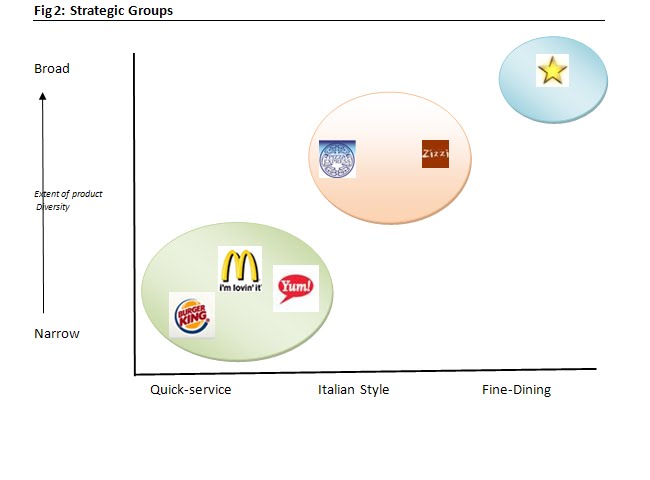
The diagram in Fig. 2 represents a strategic map of the Restaurant Industry in UK in terms of extent of product diversity (scope of the organisation’s activities) and the type of service offered (resource commitment).
The extent of product diversity is variable important to the restaurant industry since key social trends have highlighted an increasing demand for innovative foods due to a characteristic “British acceptance of foreign cuisines and willingness to try something new”. (Keynote, 2008)
However, while there is a growing demand for simple and quick services (due to a rising UK full-time working population), the same consumers are also asking for added “values” such as “restaurant experience” and better quality of the food. (Mintel, 2008)
Therefore, the type of service refers to the product/service offered to fulfil these consumers’ needs and wants; it represents the best instrument to differentiate the organisation within the industry (market sector) and it also mirrors the firm’s cost position[24].
The resulting strategic group including McDonald, Burger King and Yum! Brand can be identified, according to the Bowman’s Strategy Clock model, (Johnson et al, 2006 pp. 224-5) as group focusing on an unattractive market segment (Fast Food) pursuing a low price strategy or rather “seek to achieve a lower price than competitors whilst maintaining similarly perceived product or service benefits to those offered by competitors” (Johnson et al, 2006 pp. 224-5)

Indeed, Yum Brand Inc. as member of this group enjoys a position hardly attainable by members of others strategic groups, due to ““mobility barriers” (see Figure 3) that often involves a cost of entry that effectively gives a cost advantage over potential entrants.


Hence, this membership has allowed the firm to concentrate on a successful expansion strategy, to develop new markets (e.g. China), finance massive marketing campaigns[25]and to take part in aggressive price-wars with its group rivals.
On the other hand, the pitfall is a reduction of the profit margins (due to price-wars) being compounded by a recent rise food prices.
However, important social and economic environment changes are providing opportunities to fill new strategic spaces.
Actually, while the current economic slowdown should strengthen the low-cost strategic group, the fact that consumers are going to downtrade to an extent never seen before will mean that many are likely not to go out at all; hence, a possible rise of the demand for home-delivery, though influenced by a healthier lifestyle trend and an interest in foreign cuisine

The “Facebook” application (see Appendix III) goes in this direction but the “Pizza Hut”   menus is limited only to Pizza[26], reflecting therefore a short term objective to gain a larger market share in the younger segment of the market.
On the other hand, the Pasta Hut “makeover”, although, will probably generate a lot of curiosity (a PR stunt? ask N.Christie in Marketing Week; 16/10/08), it indicate an intent to improve the “customer experience” and differentiate the offer, profiting of the difficulties of “Italian Style” Restaurant groups, which, being mostly owned by private equity group, have been hit by the “credit crisis” more than others. (FT, 2008)
Thus, the key for the group in the present and future climate is to change and adapt in line with the marketing environment. Hence, whether it's changing the menus or changing the target customer base, the key to maximising the business is to fully understand the market.


[1] Deloitte Touche Tohmatsu (also branded as Deloitte) is one of the largest professional services firms in the world and one of the Big Four auditors, along with PricewaterhouseCoopers, Ernst & Young, and KPMG. (www.deloitte.com)
[2] “The business enterprise has two--and only two--basic functions: marketing and innovation. Marketing and innovation produce results; all the rest are costs.(Drucker cited in Forbes, 2006)
[3] The report defines restaurants as eating places that supply meals or food for consumption on the premises by UK consumers, except roadside catering and contract catering.
[4] At the end of 2006 financial year
[5] The same report forecasts a growth of 22.5% between 2009 and 2013; however with the UK economy heading towards a Recession this projection is likely to be revised downward.

[6] “The result is that there will be several high-profile casualties as the growth that was servicing debts evaporates and companies are unable to meet their obligations”. (Mintel: Restaurant, 2008)
[7] Necessities (time-poor workers), willingness to try new food and  an higher sophistication of the consumer’s taste are mentioned  by all three report consulted: Restaurant 2008 (Keynote) Pizza &Pasta Restaurant 2008 and Restaurant  2008 (Mintel) as the factors supporting  future demand
[8] Key Drivers for changes are environmental factors that are likely to have an high impact on the success or failure of strategy. (Johnson et al, 2006 p.56)
[9] The report defines restaurants as eating places that supply meals or food for consumption on the premises by UK consumers, except roadside catering and contract catering.
[10] At the end of 2006 financial year
[11] The same report forecasts a growth of 22.5% between 2009 and 2013; however with the UK economy heading towards a Recession this projection is likely to be revised downward.

[12] “The result is that there will be several high-profile casualties as the growth that was servicing debts evaporates and companies are unable to meet their obligations”. (Mintel: Restaurant, 2008)
[13] Necessities (time-poor workers), willingness to try new food and  an higher sophistication of the consumer’s taste are mentioned  by all three report consulted: Restaurant 2008 (Keynote) Pizza &Pasta Restaurant 2008 and Restaurant  2008 (Mintel) as the factors supporting  future demand
[14] Key Drivers for changes are environmental factors that are likely to have an high impact on the success or failure of strategy. (Johnson et al, 2006 p.56)
[15] The Yum! China Division (includes mainland China, Thailand and KFC Taiwan).
[16] Five year average annual growth rate of over 25% ( Yum, 2008)
[17] Managing director of the China Market Research Group
[18]Burger King joins McDonald’s and Yum! In China announcing plans to open between 250 and 300 outlets over the next five years ( The Economist, 2008)                                                                                                                                                                                                                                                                                                                                                                                                                                                                                                                                                                                                                                                                                                                                                                                                                                                                            
[19]  “China slowdown: after years of boom, powerhouse sends world a warning” (The Guardian, 2008)

[20] “An once-in-a-lifetime crisis, and possibly the largest financial crisis of its kind in human history”.( Charlie Bean, deputy governor of the Bank of England cited in The Times Online, 2008)
[21] In September 2008  the group reported a 39 per cent fall in first-half pre-tax profits, while Tragus, said like-for-like sales increased 3.4 per cent in the 12 months to May 25, compared with a 9.7 per cent increase seen the year before. (FT, 2008)
[22] "We are better suited than most to perform even in times of economic turmoil” (Novak D. cited in Forbes,2008)
[23] Today's figures from Diabetes UK show five million people are registered as obese by their GPs, up from 4.8 million in 2006-07 ,( The Independent, 2008)
[24] Indeed, a quick-service restaurant often offers simple menus with ordinary foods that can easily obtained on the wholesale market and consequently be low-priced. On the other hand, fine-dining restaurants tend to offer rare dishes that require a more expensive preparation. 

[25] Yum Brand has spent in UK in 2008 a combined £35,626,000 with the Pizza Hut and KFC brands
[26] And KFC obviously only to chicken

Bibliography 
Books

Doyle, P. & Stern, P. (2006). Marketing Management and Strategy (Fourth Ed.). London: Pearson Education Limited.

Johnson, G., Scholes, K. & Whittington, R. (2008). Exploring Corporate Strategy (Eight Ed.). London: Pearson Education Limited.

Kotler, P., Armstrong, G., Saunders, J., & Wong, V. (2005). Principles of Marketing (Fourth European ed.). London: Pearson Education Limited.

Online Articles

Yum! to you … David Novak on Yum! Brands 10 years of global growth.( 2007). Bnet [Internet], 15 October 2007. Available from: [Accessed November 10, 2008].

Yuk P.W. (2008) Tragus hurt as diners lose their appetite. Financial Times [Internet], 15 September 2008. Available from :< http://www.ft.com/cms/s/0/88e7f068-8356-11dd-907e-000077b07658.html?nclick_check=1> [Accessed November 11, 2008].

Trout, J.(2006). Peter Drucker on Marketing. Forbes [Internet],07 March 2006. Available from: [Accessed November 6, 2008].

Yum brands predicts profit growth for 2009. (2008). Forbes [Internet], 06 August 2008. Available from: [Accessed November 03, 2008].

O'Flaherty, K., (2008). Marketing Trends: In the name of progress - Marketing Week. [Internet], 16 October 2008. Available from: [Accessed November 13, 2008].

McDonald's profit up, but worries weigh.(2008). Reuters [Internet], 22 October 2008. Available from: [Accessed November 11, 2008].

Clark, N. (2008). Marketing can prove its worth in the boardroom. The Economic Times [Internet],15 October 2008. Available from: [Accessed 05 November 2007].

Wearden G. and Stanway D. (2008) China warns financial crisis is damaging its economic growth The 
Guardian. [Internet], 21 October 2008. Available from:

Laurance, J., (2008). Diabetes may cause first fall in life expectancy for 200 years . The Independent. [Internet], 20 October 2008. Available from :< http://www.independent.co.uk/life-style/health-and-wellbeing/health-news/diabetes-may-cause-first-fall-in-life-expectancy-for-200-years-966914.html> [Accessed November 15, 2008].

Name change for Pizza Hut (2008) The Independent. [Internet], 06 October 2008. Available from: [Accessed November 15, 2008].

Websites

Deloitte Global Home Page - Deloitte Touche Tohmatsu [Internet]. Available from: [Accessed November 14, 2008].

Restaurant (2008) Keynote [Internet], October 2008. Available from: < http://0-www.keynote.co.uk.lispac.lsbu.ac.uk/kn2k1/CnIsapi.dll?nuni=34041&usr=11844srv=03&alias=kn2k1&uni=1226711466&fld=J&Jump=ViewPDF>[Accessed 05 November 2008].

Pizza and Pasta Restaurants - UK January 2008- Market Research Report (2008). Mintel [Internet], January 2008. Available from: [Accessed 06 November 2008].

Restaurants - UK - April 2008 - Market Research Report. (2008). Mintel [Internet], April 2008. Available from:

Yum! Brands, Inc. (2008).[Internet]. Available from: [Accessed November 10, 2008].

Online Journal Articles

Allen, R.S. & Helms, M.M. (2006). Linking strategic practices and organizational performance to Porter's generic strategies. Business Process Management Journal, 12(4), 433-454. Available from: [Accessed November 10, 2008].